
No Output · Gauteng
Engine Running.
No Power Out.
If the engine runs but no power reaches your building, the fault is on the electrical side: a tripped breaker, the AVR, lost excitation, the alternator windings or the changeover. That is different from low voltage, and from voltage that keeps moving. We measure the output at the alternator, the breaker and the changeover switch across Gauteng before any AVR or rewind work.
Callout fee waived when you accept our written quote. 1-year workmanship guarantee. See prices
- Output voltage diagnosis
- AVR and breaker checks
- Alternator winding tests
- Onsite Gauteng repairs
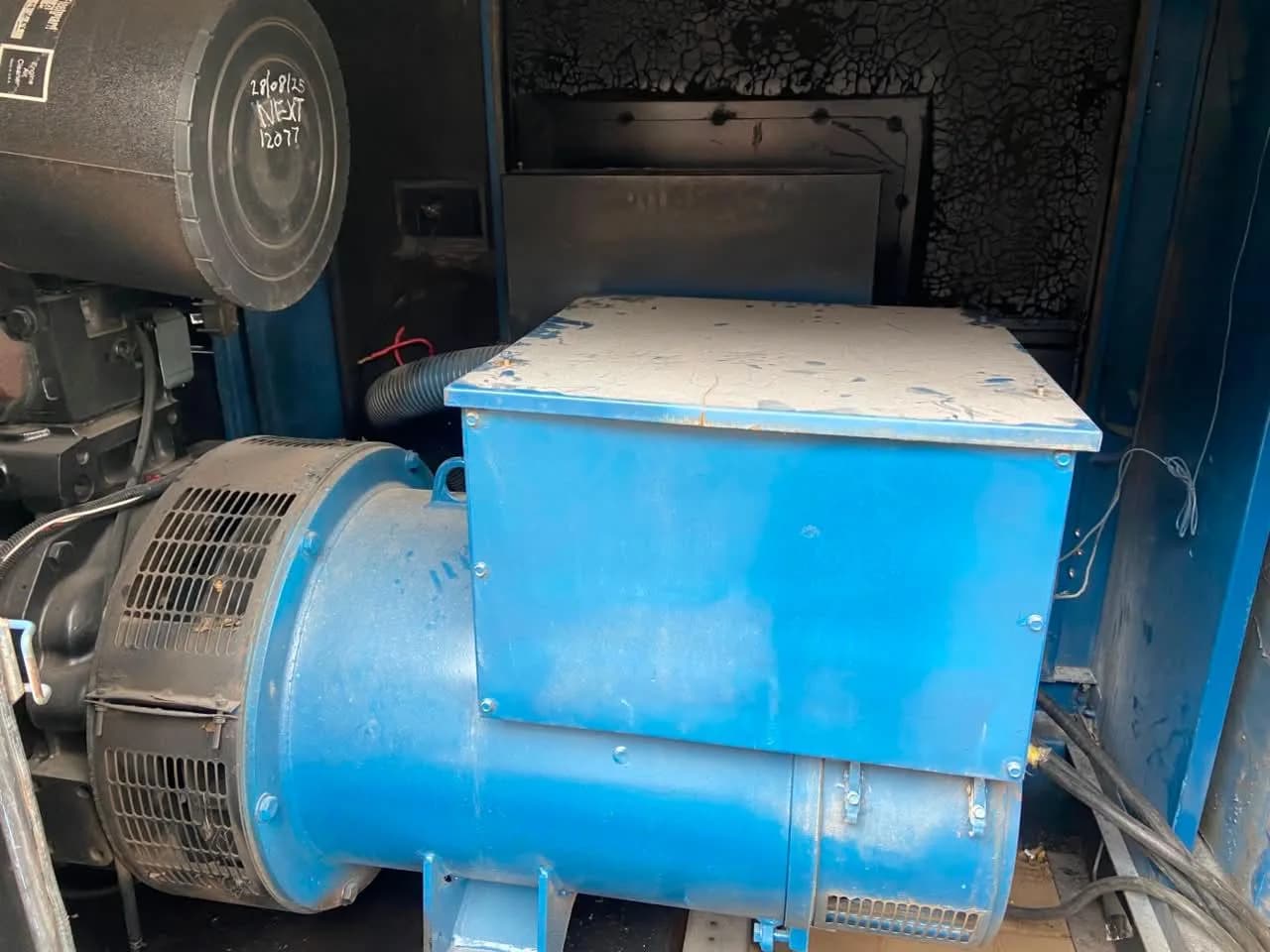
The Fault
What causes a generator to produce no power?
When the engine runs at the right speed and the building still has no power, the fault sits on the electrical side of the set. The engine may be perfectly healthy while a failed AVR, a tripped output breaker, lost residual magnetism or a winding fault sits between the alternator and your distribution board.
The first split is simple: is there voltage at the alternator terminals, and does it reach the changeover switch? We measure both against South Africa’s standard low-voltage supply of 230 V between phase and neutral (NRS 048-2) before we open the AVR or talk about rewinding. A tripped breaker or a failed transfer contact can make a healthy alternator look dead.
If the terminal voltage is missing or unstable, we test the automatic voltage regulator and the excitation circuit. When the engine sounds normal and the lights stay off, the AVR is a common culprit. Voltage that rises and falls with load belongs to the same family of faults, not to the fuel system.
If the windings are open, burnt or have failed insulation, the repair changes. We recommend rewinding only after electrical tests show the AVR and breakers are not the cause, because a rewind costs far more than the regulator or breaker that might have restored output.
Set running, no power?
Call or WhatsApp 082 057 4605. We are open 24/7 and arrive within 1 hour for breakdowns.
Fault guide
Generator running but not producing power: what it can mean and what to do
If the engine runs but no power reaches your sockets or building, the fault sits in the alternator, the AVR, a breaker or the changeover. We measure along that path to find where the power stops. This guide separates what you can safely notice from what a qualified technician tests. One symptom never proves that a particular part has failed.
Symptom, likely cause and repair
Find the line closest to what you see. The cause is the most likely one, not a diagnosis: testing confirms it before any part is replaced.
| What you see | Likely cause | Usual repair |
|---|---|---|
| Engine runs, the controller shows 0 V | AVR or excitation failure | AVR repairs |
| Voltage at the generator, none at the building | A tripped output breaker or a changeover fault | Changeover switch repairs |
| No output after the set stood unused for a long time | Loss of residual magnetism in the alternator | Alternator repairs |
| No output after a power surge or storm | Damaged diodes, AVR or windings | Alternator repairs |
| Power on some phases only | A winding, connection or breaker fault on one phase | Alternator repairs |
01
What you may notice
- The engine runs normally but there is no power at the sockets or the building
- The controller shows zero or very low voltage
- The generator runs but the changeover does not switch over
- Power stopped suddenly while the set kept running
02
Possible causes
Any of these can produce the same symptom. Testing decides which one applies.
- A tripped output breaker or a blown fuse
- Loss of excitation (residual magnetism) in the alternator
- A failed AVR or a fault in its sensing
- Alternator winding, diode or capacitor faults
- A changeover switch (ATS) that has not transferred the load
- Loose or burnt output connections
03
What you can safely check
Look and note only, from outside the canopy. Do not open panels, covers, fuel lines or the cooling system.
- Is the output breaker on the generator in the on position? Look without opening the panel.
- Does the controller display show a voltage reading?
- Did the power stop suddenly, or after a surge, storm or overload?
- On a standby set, does the changeover indicator show generator or mains?
04
Stop using the generator and call if you notice
- A burning smell from the alternator or control panel
- Smoke, sparking or scorch marks at connections
- Breakers that trip again as soon as you reset them
If it is safe to reach, stop the generator with its normal stop control or emergency stop, keep people away, and call a technician.
05
What a qualified technician typically tests
These are technician checks, not steps to try yourself. Several involve live electrical measurement, fuel or pressurised systems.
- Output voltage at the alternator terminals, with the supply made safe to measure
- Excitation, AVR output and sensing
- Alternator windings, diodes and, on brushless sets, the rotating rectifier
- Breakers, fuses and output connections
- Changeover switch operation and its control signal
06
Common repair categories
The repair follows the test result. These are the services this symptom most often leads to.
07
What to send when you book
- Your suburb and how we reach the generator
- Make, model and kVA from the data plate (a photo is ideal)
- Fuel type: diesel, petrol or gas
- Whether the controller shows any voltage
- What happened just before the power stopped
08
Related faults and services
Not sure which symptom fits? Try the generator symptom finder.
Safety before you check anything
- Exhaust contains carbon monoxide, which you cannot see or smell. Run a portable generator outdoors only, away from doors, windows and vents, and never run any generator in a house, garage or other enclosed space.
- A standby generator set to automatic can start at any moment, when the mains fails or on its exercise timer. Keep the canopy closed and stay clear of fans, belts and the exhaust.
- Generator output, the changeover and the control panel can be live, and some parts hold stored electrical energy after shutdown. Leave panels, covers and wiring closed for us to open.
- The engine, exhaust and coolant stay hot after running. Never open a radiator or coolant cap on a hot engine.
- Do not refuel a running or hot generator. If you smell gas at a gas-fuelled set, do not operate switches; leave the area and contact your gas supplier.
Carbon monoxide guidance: US Consumer Product Safety Commission: Generators and engine-driven tools (carbon monoxide).
Send the details on WhatsApp
This opens WhatsApp with a short message already typed: brand, model, capacity, symptoms and suburb. Fill in what you know and send it. Blank lines are fine.
- The data-plate photo is added inside WhatsApp after the chat opens: tap the attachment or camera icon and choose the photo. A link cannot attach the photo for you.
- Take the photo only when the generator is switched off and has cooled down. Do not reach over or into a running or hot generator, and keep away from the exhaust.
- A standby generator set to automatic can start by itself when the mains supply fails. If you are not sure how it is set, photograph the plate from a distance or send a photo of the whole set instead.
Typical repair costs for this fault
Published ranges, last reviewed October 2026. The callout is R400 – R700 in business hours and R700 – R1,400 after hours, and it is waived if you accept the quote. Your written quote after diagnosis is the price that applies.
- Voltage fluctuation diagnosis and repair
- R1,500 – R5,000
- AVR replacement
- R2,200 – R9,000
- Alternator rewinding
- R6,000 – R18,000+
Step 9: book a diagnosis visit.
How We Diagnose
Measure the path before replacing the AVR
- 01
Confirm engine speed
We check that engine speed is stable. Low speed collapses the voltage and points to the engine or governor, so we do not start with the AVR.
- 02
Measure along the path
We measure voltage at the alternator, after the breaker and at the ATS. That sequence shows exactly where the output is lost.
- 03
Test the AVR and windings
Once we know where the output stops, we test regulator output, residual magnetism and winding insulation.
- 04
Repair and check under load
After the repair, we confirm the voltage under real load, not only at idle.
Specialist Follow-On
AVR, switching or windings — not the same repair
No output is the symptom AVR repairs exist for. If our tests show the regulator or excitation circuit has failed, we repair it or fit a replacement matched to your alternator. A generic AVR that is not set up for the alternator can bring the low or high voltage straight back.
If the insulation tests fail, the job becomes generator rewinding. AVR repairs and rewinding are the two specialist follow-ons from this diagnosis, and they are very different jobs.
AVR repair
Restore excitation and stable voltage
Breaker and ATS
When the set is live but the building is not
Rewinding
When the windings have actually failed
Load check
Prove output at light and working load
Common Questions
No power from a running generator
Why does my generator run but produce no power?
Because the electrical side has failed while the engine runs on. The usual causes are a failed AVR, a tripped output breaker, lost residual magnetism or an open winding. We measure voltage at the alternator before we recommend any of those repairs.
Is no power always the AVR?
No. The AVR is a common cause when the engine sounds normal, but breakers, transfer switches and winding faults leave the building just as dark. Replacing the AVR without testing can waste the part.
Can a tripped breaker look like a dead generator?
Yes. If the engine runs and the panel shows voltage, we check the output breaker and the changeover switch next. Resetting a breaker without finding the overload or short will not hold, so please do not keep resetting it.
Will this damage appliances?
Unstable or high voltage can. If the lights surge or equipment trips, stop using the set and let us measure the output. A failed AVR is harder on connected equipment than on the engine.
Why is generator voltage low?
Low voltage on a running set can come from the AVR, engine speed, the load, the wiring or the alternator. We measure frequency and voltage together, so we never fit a new regulator to an engine that is simply running slow.
Can the alternator cause a generator to produce no power?
Yes. Once we have ruled out the breaker and the AVR, we test the windings and assess them for rewinding. We also repair Leroy-Somer alternators, a common make on diesel sets.
Still unsure what the fault is? Call or WhatsApp 082 057 4605 for onsite diagnosis.
Related Services
Repairs that restore output
- Alternator Repairs Output end when there is no usable power
- Low Voltage Voltage is present but too low
- Generator Repairs Full onsite repair service
- Emergency Generator Repair When the building stays dark
- AVR Repairs Voltage regulator diagnosis
- Generator Rewinding Stator and rotor rewind
- Control Panel Repairs ATS and output switching
- Load Bank Testing Prove output under load
- Contact Call or request a quote
Service Areas
No-output callouts across Gauteng
We diagnose generators that run without power in Johannesburg, Pretoria, Sandton, Centurion, Midrand, Fourways and surrounding areas.
What to send before we attend
These details help us plan the visit and bring the right parts. Send what you can on WhatsApp; if you can’t find the model number, we still book the visit.
- Location
- The suburb or site, so the visit can be booked in the right area.
- Make and model
- The generator brand and model, if they are known.
- kVA
- The size printed on the data plate.
- Fuel type
- Diesel, petrol, LPG, natural gas, or dual-fuel.
- Controller model
- The module name on the panel, when it is visible.
- Fault or alarm
- What the set does, and any text on the screen.
- Photos
- The generator, the data plate, and the controller or alarm. Send these on WhatsApp.
Book a Diagnosis
Running, but nothing on the board?
Tell us whether the engine sounds normal and whether the generator panel shows any voltage. That tells us whether to start with the AVR or the transfer switch.
- Call
- 082 057 4605
- Message us on WhatsApp
What happens next
- We reply with questions about the generator, or to book a visit.
- A technician comes to you. For a breakdown we arrive within 1 hour.
- The fault is diagnosed on site and you get a written quote. No work starts until you accept it.
Charlie, lead technician: Degree in Mechanical Engineering, Degree in Electrical Engineering, Diesel Plant Fitter. Generator specialists since 2000.