
Business premises · Servicing and maintenance
Commercial Generator Servicing & Maintenance Across Gauteng
Commercial generator maintenance and servicing on site for offices, shops, restaurants, complexes, schools, clinics, hotels and small warehouses, planned around your trading hours. We are open 24/7, so early mornings, evenings and weekends can be booked, and you get a free written quote first. Breakdowns go to our commercial repairs page.
Callout fee waived when you accept our written quote. 1-year workmanship guarantee. See prices
- Planned around trading hours
- Contracts and SLAs per site
- 1-year workmanship guarantee
- Onsite across Gauteng
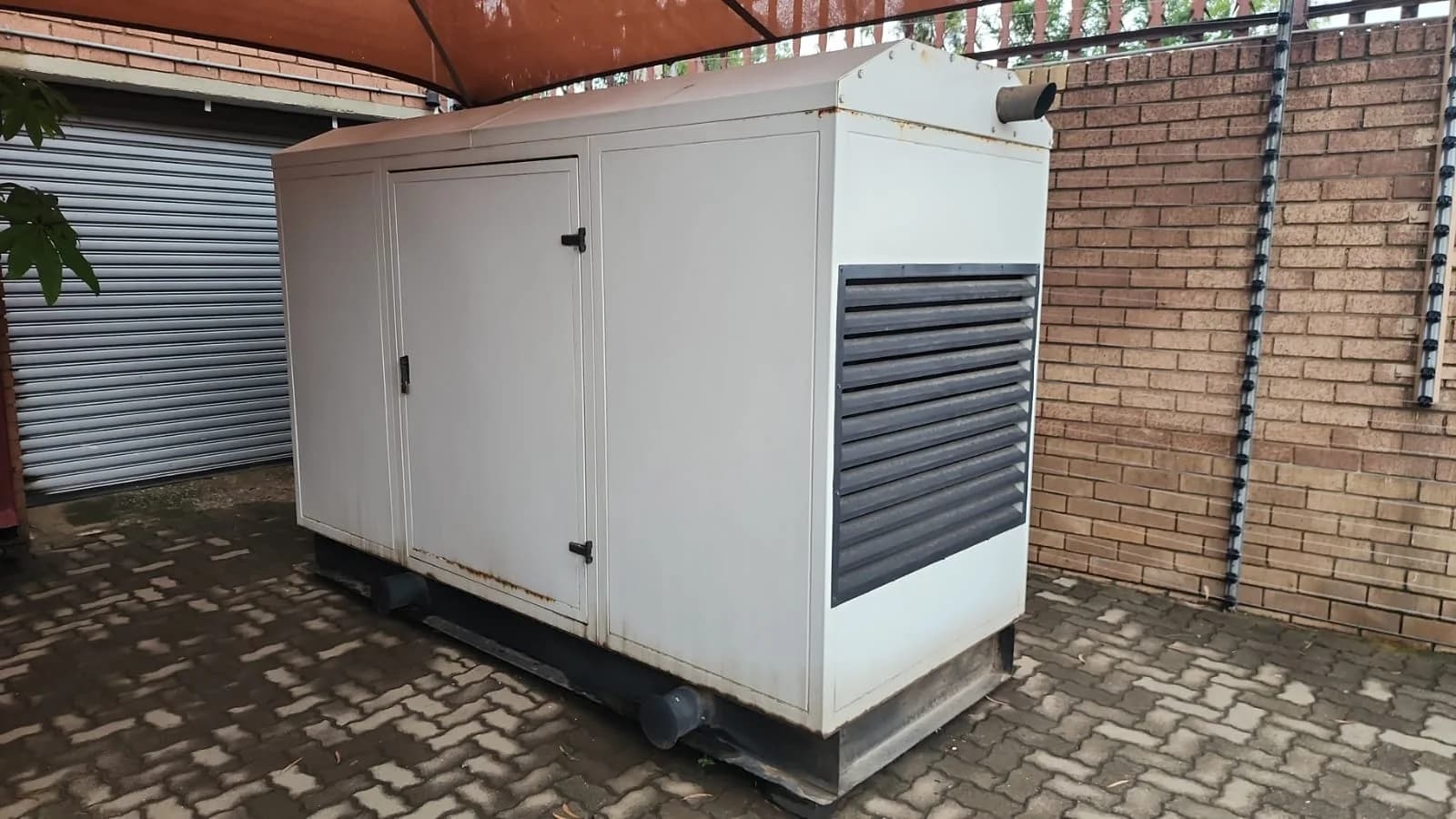
One set, one building
Servicing a business generator around the business
Most business premises rely on a single diesel standby set that starts itself through an ATS, is run by a controller such as a Deep Sea, SmartGen or Datakom module, and lives in a plant room, a basement or a corner of the yard. That one machine carries the tills, the lights, the network cupboard and often a lift or a cold room. When it fails to take over, the bill is lost trading, spoiled stock and tenants on the phone, so the point of maintenance is a set that starts, transfers and holds the building every time.
Hours alone mislead on a business set. A generator that barely ran last year can still be due, because oil, coolant, stored diesel and the starter battery age whether the engine turns or not. Offices and schools that close over December are the usual case. We plan commercial visits by the calendar first and bring them forward when long outages add running hours.
Each visit leaves a record of the date, running hours, work done, parts fitted, readings and findings, which you can pass to a landlord, trustees, an insurer or an auditor. Tell us who meets us on site and who signs off the work, and we book every visit through that person.
Maintenance contracts and service level agreements (SLAs) are customised for each client. We inspect and assess the generator, its condition, capacity and usage, and your requirements, then quote the plan in writing. There are no fixed packages or prices.
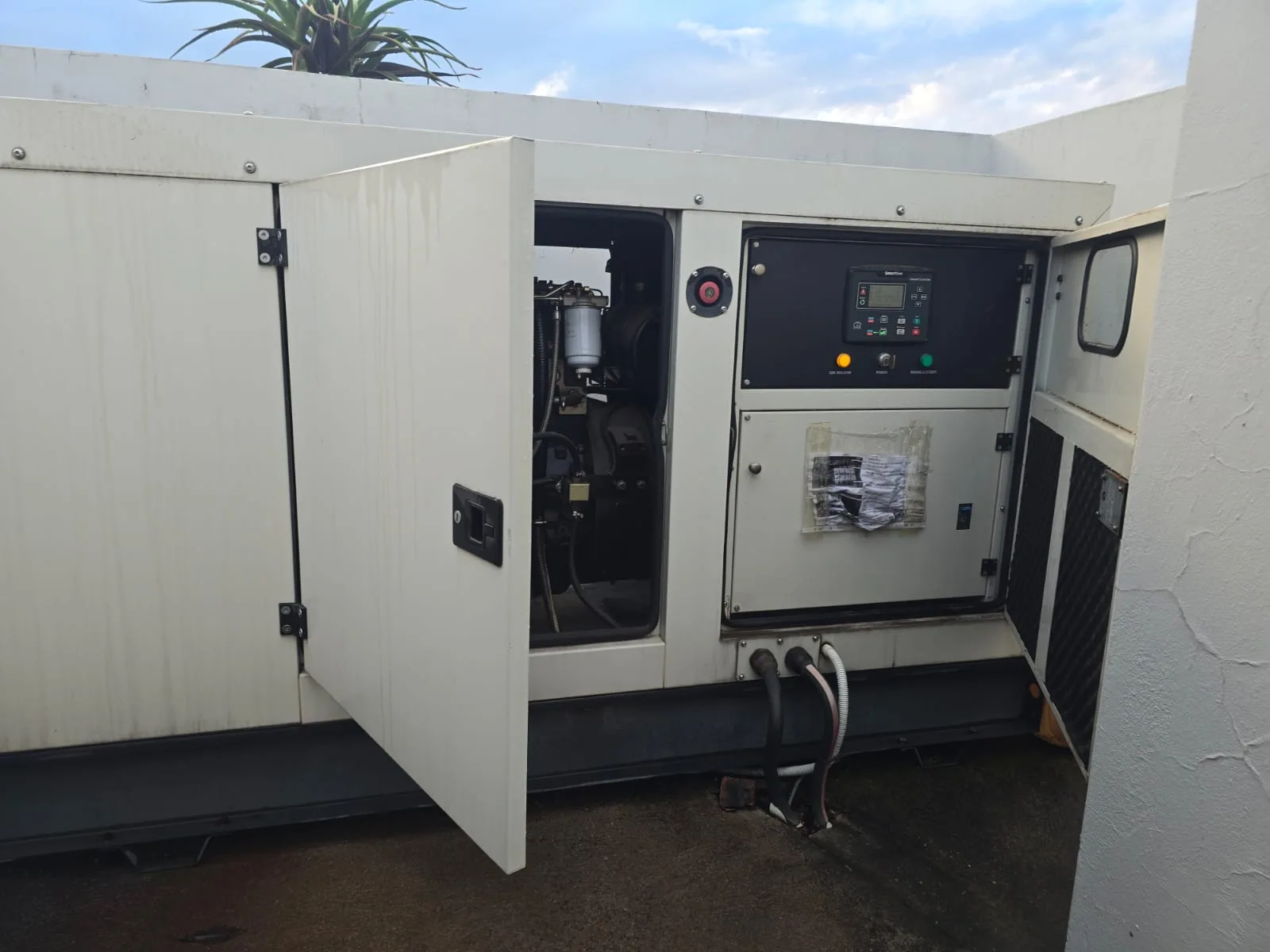
On the day
What a commercial servicing visit covers
A business service looks after the building’s needs as well as the engine’s. These are the nine things we work through.
Service items due for the engine
Oil, filters and the other items your engine maker lists for this interval are replaced, matched to the hour reading and the date of the last visit.
Starter battery and charger
We test the battery under load and confirm the mains charger keeps it topped up, because a weak battery is what leaves a building dark on a cold morning.
Fuel in the canopy and bulk tank
We check the level, water and condition of the diesel in the base tank and any separate bulk tank, so a long outage does not end in a blocked filter.
Controller alarms and settings
We read the alarm history, hour counter and auto-start settings on the controller, and deal with the cause of a warning rather than just silencing it.
Changeover as a controlled test
The ATS is checked as a controlled test of the changeover. A transfer that puts the whole building on the generator is agreed with you first.
Notice for tenants
When a test moves the building onto the set, we fix the time with the centre or building manager so tenants and staff hear about it in advance.
The loads that matter
Tills and IT, cold rooms and fridges, lifts, air-conditioning and kitchen extraction: we note what the set must carry and watch those loads come on.
Voltage and frequency on load
With the set carrying load we read voltage and frequency and check they hold steady, so sensitive equipment on your board gets a clean supply.
The visit record
Before we leave you have the record: date, running hours, work done, parts fitted, readings and anything to keep an eye on before the next visit.
What different premises need from a maintenance plan
The engine work is much the same from one site to the next. What changes is the load the set has to carry and the people who need to know about a test. Each row links to the page with more detail.
| Premises | What matters | Related page |
|---|---|---|
| Offices and business parks | Server rooms and lifts have to ride through the changeover. A load bank test proves capacity where the building load is too light, or too important, to test on. | Load bank testing |
| Retail and restaurants | Cold rooms, fridges and extraction fans draw a surge as they start, so the plan checks that the set picks them up without tripping. | Generator trips under load |
| Body corporates and estates | Gates, lifts, pumps and common lighting share one set, and access and notice run through the managing agent or the trustees. | Body corporate maintenance |
| Schools and clinics | Sets stand through holidays and quiet spells, so batteries and fuel are checked on the calendar even when the hour meter hardly moves. | Generator not used for months |
| Small warehouses and workshops | Longer runs add hours quickly, so the plan follows the engine’s hour interval as closely as the date. | Diesel servicing and maintenance |
| Several branches on one contract | One plan can cover sets at several addresses, with a separate record kept for each generator. | How maintenance contracts work |
The callout fee is only payable if you do not accept the quotation. If you accept the quotation, the callout fee is waived. A basic service (inspection and fluids) is typically R900 to R1,800, and your written quote gives the figure for your set. The cost guide lists the other published prices.
Warning signs
Signs a business generator is due
Any one of these is a reason to book a visit before the date on your plan comes round.
01
It tripped as the building came on
The set started, then dropped out when the tills, lights or air-conditioning switched over to it during the last outage.
02
It ran but never took the building
The engine was running in the plant room while the offices or shop floor stayed dark, which points at the transfer, not the engine.
03
The transfer stalled
The changeover hesitated or hunted between mains and generator, leaving staff waiting and equipment rebooting more than once.
04
Cold room alarms during the outage
Temperature alarms on fridges or cold rooms while the set was meant to be carrying them suggest it is not picking up the surge.
05
An alarm acknowledged, not cleared
Someone pressed the button to silence a warning on the controller, and the cause is still sitting there waiting for the next start.
06
Past the plan
The set has gone beyond the hours or the months set for its next service, often because a busy quarter pushed the visit back.
07
A new load since the last visit
A tenant added air-conditioning, a kitchen or a server rack, and nobody has checked whether the set can still carry the building.
08
Slow to crank on a test
The starter turns over slowly or needs a second attempt, the usual early sign of a battery or charger that will not last.
09
Leaks, smoke or a new noise
Oil or coolant under the set, smoke on start-up or a sound that was not there before all justify a visit whatever the meter says.
Related Pages
Commercial repairs, contracts and testing
- Commercial Generator Repairs Breakdowns and faults at business premises
- Body Corporate Maintenance Shared sets, trustees and residents
- Generator Maintenance How contracts and SLAs are set up
- Load Bank Testing Proving the set can carry the building
- Industrial Servicing & Maintenance Factories and heavy plant
- Standby Generator Maintenance Keeping a backup set ready to start
- Diesel Servicing & Maintenance The engine behind most business sets
- ATS Repairs When the changeover lets you down
- Generator Controllers Alarms, modes and settings
- Generator Sizes kVA for a business load
- Generator Callouts How a visit is booked
- Generator Servicing The general servicing page
Common Questions
Questions about commercial generator maintenance
How often should a commercial standby generator be serviced?
At least once a year, or at the engine maker’s hour interval if the set reaches it first. Busy sites with long outages or critical loads usually need interim visits between full services. Your own engine’s manual gives the exact figure for your set.
Can you service our generator after hours so trading isn’t interrupted?
Yes. We are open 24/7, so a service can be booked for an early morning, an evening or a weekend when the building can manage without backup power for a while. Planned work is quoted in writing before the visit.
What does a commercial generator maintenance contract include?
It is written for your site after we assess the set: the visit schedule, what each visit covers, any load testing and the records you receive. If the generator breaks down between visits, contract clients are scheduled ahead of new callouts. Preferred labour rates may apply to repairs on sets covered by a contract, and every repair is still quoted in writing first.
Do we get a record of each visit for the landlord, insurer or auditor?
Yes. Every visit is recorded with the date, running hours, work done, parts fitted, readings and findings, ready to file or forward to whoever asks for it.
How much does commercial generator servicing cost?
A basic service (inspection and fluids) is typically R900 to R1,800. The final figure depends on the size of the set and the items due, and you receive a free written quote, valid for 14 days, before any work starts.
Can one contract cover several branches or buildings?
Yes. Generators at several addresses can share one maintenance contract, each with its own schedule and its own record, so every set’s history stays separate.
Do you do load bank testing for commercial generators?
Yes. A load bank applies a controlled load in steps and records voltage, frequency and temperature, which proves capacity without risking your tenants’ equipment. Our cost guide puts load bank testing at R2,800 to R5,500. Send the kVA rating and we confirm the test for your set.
What is the difference between commercial and industrial generator maintenance?
Commercial maintenance looks after the standby set that serves one business building, usually somewhere between about 30 and 500 kVA, planned around trading hours and tenants. Industrial maintenance covers heavy plant at factories and processing sites, often on prime duty, serviced by running hours inside shutdown windows.
Still unsure what the fault is? Call or WhatsApp 082 057 4605 for onsite diagnosis.
Service Areas
Servicing & maintenance across Gauteng
Servicing and maintenance visits are booked for a time that suits you. Choose your area for the suburbs, site types and plans we cover there.
- Generator servicing & maintenance in Johannesburg
- Generator servicing & maintenance in Sandton
- Generator servicing & maintenance in Randburg
- Generator servicing & maintenance in Midrand
- Generator servicing & maintenance in Roodepoort
- Generator servicing & maintenance in Pretoria
- Generator servicing & maintenance in Centurion
- Generator servicing & maintenance on the East Rand
- Generator servicing & maintenance in Kempton Park
- Generator servicing & maintenance on the West Rand
What to send before we attend
These details help us plan the visit and bring the right parts. Send what you can on WhatsApp; if you can’t find the model number, we still book the visit.
- Location
- The suburb or site, so the visit can be booked in the right area.
- Make and model
- The generator brand and model, if they are known.
- kVA
- The size printed on the data plate.
- Fuel type
- Diesel, petrol, LPG, natural gas, or dual-fuel.
- Controller model
- The module name on the panel, when it is visible.
- Fault or alarm
- What the set does, and any text on the screen.
- Photos
- The generator, the data plate, and the controller or alarm. Send these on WhatsApp.
Book a Visit
Arrange commercial generator servicing
Tell us the type of premises, the suburb, the kVA, your trading hours and who will meet us on site. We come back with a time that suits the business and a written quote.
- Call
- 082 057 4605
- Message us on WhatsApp
What happens next
- We reply with questions about the generator, or to book a visit.
- A technician comes to you at the booked time.
- The fault is diagnosed on site and you get a written quote. No work starts until you accept it.
Charlie, lead technician: Degree in Mechanical Engineering, Degree in Electrical Engineering, Diesel Plant Fitter. Generator specialists since 2000.